



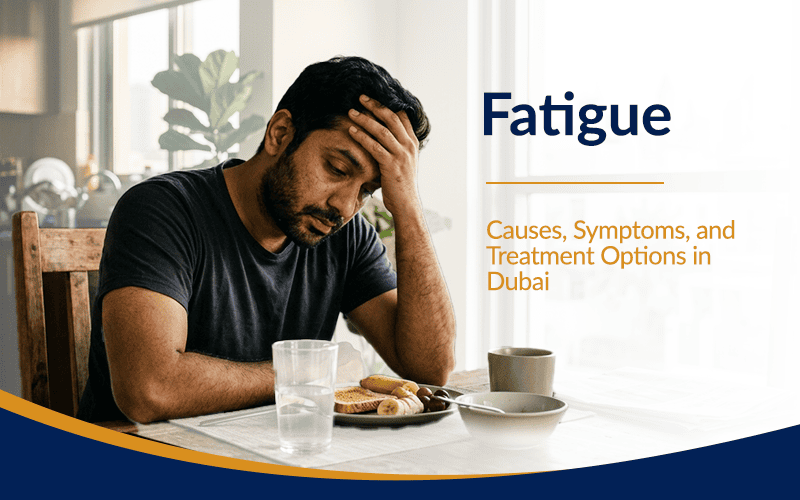
It is natural to feel exhausted after a long busy day. But what if you wake up feeling weary, can’t focus at work, or feel like you don’t have much energy even if you’ve had enough sleep?
Ongoing or chronic tiredness may impact crucial aspects of your life, such as your daily duties, school, job, and relationships.
Dubai’s fast-paced life demands long working hours, travel, and changes between outdoor heat and air-conditioned environments. During summers, heat exposure and dehydration can intensify the experience of fatigue. In fact, heat exhaustion can include symptoms such as fatigue, thirst, headache, dizziness, and nausea.
That said, exhaustion isn’t necessarily about your lifestyle. It may sometimes be a beginning point and a clue to underlying diseases such as anemia, diabetes, and thyroid disorders.
What is Fatigue?
Fatigue is one of the most common symptoms reported by people across chronic conditions. It may occur alongside a diagnosis or as an early sign or symptom for months/years before you receive a clinical diagnosis.
What does fatigue mean? It refers to a sense of extreme fatigue or exhaustion that doesn’t go away and may make it difficult to carry out normal everyday tasks.
Generally, you can categorize it into two types: [a] acute and [b] chronic fatigue. Chronic fatigue lasts for six months or longer.
There’s another way to look at it in this manner: trait and state fatigue.
- Trait fatigue: Fatigue experienced over a long period of time in a relatively stable manner. It is a symptom associated with physical and mental illnesses.
- State fatigue: It is a temporary change in your motor or cognitive performance as well as the subjective experience of exhaustion. It occurs in the context of a specific motor or cognitive (mental) task.
Symptoms of Fatigue
Fatigue can manifest itself as [a] feeling tired during the day, [b] making grasping or snorting noises at night, [c] snoring loudly, [d] lack of energy, [e] short breaths, [f] feeling very thirsty, [g] weight loss, [h] peeing more often (especially in night), [i] feeling nervous, [j] muscle weakness, and [k] problems with thinking, memory and concentration.
Causes of Fatigue
Now that you recognize the symptoms of fatigue, let’s look at some prominent causes of fatigue.
Insomnia
Research suggests that people who experience more insomnia symptoms, daytime sleepiness, or depressive symptoms are more likely to report higher levels of fatigue. Moreover, longer usual sleep duration is also linked to higher fatigue levels.
Individuals with insomnia find it difficult to sleep at night, making it challenging for their body to undergo restorative activities and rest well. Lack of sleep gives rise to “sleep fatigue,” compounding exertion that occurs when your body’s need for restorative sleep exceeds what it actually gets.
Due to this, the individual may experience challenges with concentration, cognition, irritability, and productivity.
Anemia
Anemia is a medical condition wherein your blood is unable to carry the required amount of oxygen necessary to fuel your cells. Look at it this way. Every cell in your body requires oxygen to produce energy. When your hemoglobin levels drop below the normal limits, the oxygen supply shrinks.
If you have anemia, your body has either fewer red blood cells or less hemoglobin per cell. This means your body is producing less energy and delivering less oxygen to your tissues with each beat. Your body responds with weariness and weakness.
Hormonal Changes
Hormones are chemical messengers that regulate almost all bodily processes.
| Hormone | What it regulates | Concerns |
| Thyroid (T3 and T4) | Regulate your body’s metabolism, directly affecting energy production. | If your thyroid hormone levels go down, your metabolism slows and your body produces less energy. |
| Cortisol | Influences your body’s energy and stress response. Specifically, it controls blood sugar, metabolism and inflammation. | When cortisol levels are consistently high or low, it disrupts the process and you end up feeling worn out and weary. |
| Sex hormones | Estrogen and progesterone affect sleep quality (indirectly affecting energy). Testosterone, in contrast, is associated with energy, muscle mass, and mood. | Any fluctuations in these can lead to fatigue. |
| Melatonin | Affects your sleep-wake cycle | Disruptions due to artificial light or irregular sleep schedules can lead to poor sleep quality. |
Diabetes
Many people with diabetes experience significant fatigue. This diabetes-induced fatigue results from either the blood sugar levels being too low, too high, or swinging between the two.
For instance, high blood sugar levels slow down circulation. This means your body cells don’t get oxygen and nutrients efficiently. Plus, the kidneys overwork to filter the excess glucose while pulling water with it. Thus, leaving you dehydrated, which compounds into fatigue.
Low blood sugar levels can result in fatigue too. When the levels drop, your brain loses access to its primary energy source. This immediately leads to shakiness, a fast heartbeat, and weakness. Recurring patterns like these create a pattern of energy crashes, which cause deep fatigue.
Heart Conditions
Cardiac illnesses restrict the heart’s ability to pump blood and oxygen effectively to your body’s tissues. When your muscles receive less oxygen and nutrients, they have less energy available for everyday activities. This can make you feel tired or weak, even after relatively little exertion.
Moreover, your body may respond by increasing the heart rate and breathing to maintain blood flow. This extra effort makes small everyday things tiring.
Stress and Emotional Wellbeing
[a] Work pressure, [b] major life changes, [c] anxiety, and [d] depression are all associated with fatigue. This does not mean that feeling tired is a sign of a mental health condition. Fatigue can occur alongside persistent low mood, loss of interest, anxiety, changes in sleep, or difficulty managing everyday activities.
When Should You See A Doctor?
Fatigue becomes alarming and requires medical consultation when [a] it does not get better with regular sleep and rest, [b] it is affecting your daily activities, [c] there is unusual change in your weight, [d] it is accompanied with frequent dizziness or weakness, [e] you’re experiencing changes in sleep pattern, and [f] you have other symptoms that are concerning.
How Do You Diagnose Fatigue?
There is no single test that can diagnose fatigue. However, your doctor will ask you about your symptoms, lifestyle, medications, medical history, and how long you have been feeling tired.
Depending on the discussion, the doctor may call for tests to identify the reason behind the fatigue.
What Are the Treatment Options for Fatigue?
Treatment and management of fatigue depend on the root cause of the issue.
If poor sleep is contributing to your symptoms, improving your sleeping routine or medically treating the sleeping disorder may help.
Similarly, if a medical condition such as anemia or diabetes is contributing to fatigue, the treatment option will focus on managing that condition.
Lifestyle changes, like maintaining a balanced diet, staying hydrated, regular physical activity, managing stress, and a consistent sleep schedule can help.
Frequently Asked Questions
Is fatigue the same as feeling tired?
Tiredness is not the same as fatigue. It’s normal to feel exhausted after a long day, a lot of exercise, or a bad night’s sleep. Rest typically helps. Fatigue, in contrast, is a chronic tiredness that develops over time and impacts your everyday functioning.
Can dehydration cause fatigue?
Yes, dehydration can contribute to tiredness, weakness, dizziness, headaches, and other symptoms, particularly during periods of high heat and sweating.
Can you treat fatigue?
Yes, you can treat fatigue by solving what’s causing it. Improving your sleep, nutrition, hydration, physical activity, and reducing stress levels can help in some cases.
Conclusion
It’s okay to feel tired now and then. If it lasts for a length of time, and interferes with your everyday activities to a large degree, it’s worth talking to your doctor about it.
Doctors at Dubai Medical University Hospital can assist you in making sense of your fatigue and examining the factors that are causing it. Based on the analysis, they will recommend testing to confirm the cause and come up with a personalized treatment plan to help you overcome the concern.
This article is for informational purposes only and does not constitute medical advice. Always consult a qualified healthcare professional for diagnosis and treatment. If you are experiencing a medical emergency, call 998 (UAE) or visit the nearest emergency room immediately.
