



If your periods have always been painful and you’ve always assumed that’s just how it is for you, it’s worth knowing that severe period pain is not something you have to live with. For many women, that pain has a name. It’s endometriosis.
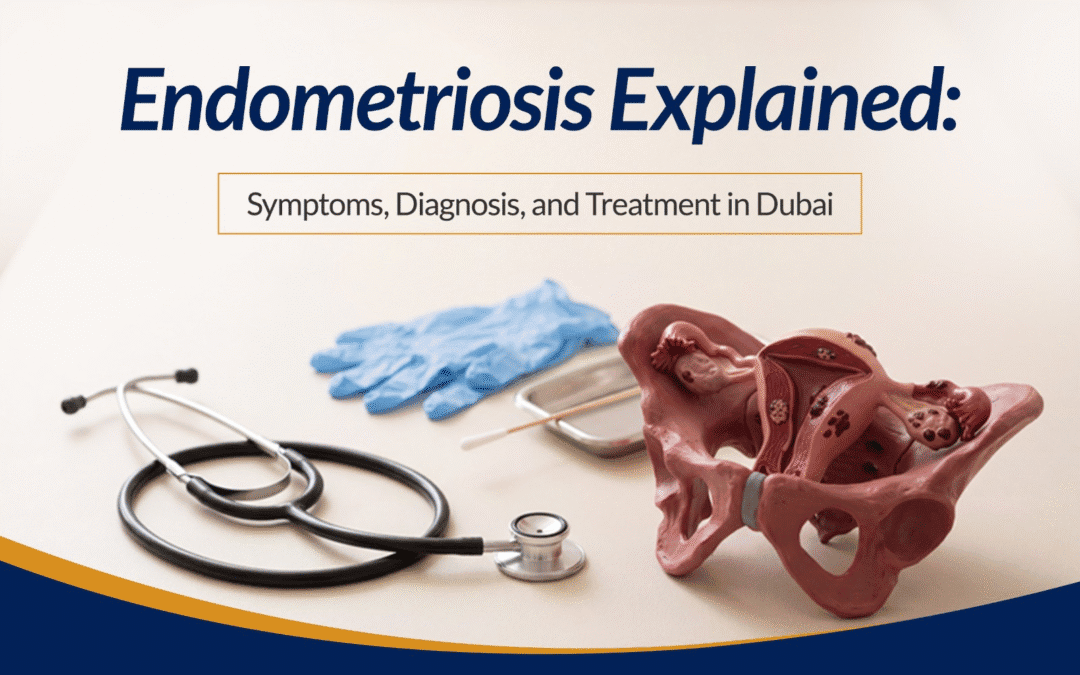
Endometriosis is a condition where tissue similar to your uterine lining grows outside the uterus, most commonly on your ovaries, fallopian tubes, and the tissue lining your pelvis.
It affects any women in the and beyond the reproductive age. The World Health Organization puts that number at around 190 million women of reproductive age worldwide, roughly 10% of all women in this group.
If you’ve been experiencing unusually painful periods or heavy bleeding, it might be worth to get checked for endometriosis.
This guide covers what endometriosis actually is, the symptoms worth paying attention to, how a diagnosis is reached, and what your treatment options look like here in the UAE.
- What Is Endometriosis?
- Symptoms: What to Watch For
- How Endometriosis Is Diagnosed
- Treatment Options
- Endometriosis and Fertility
- Meet Dr. Bedayah Amro: Consultant Gynaecologist at DMUH
What Is Endometriosis?
Endometriosis happens when tissue similar to your uterine lining grows in places it shouldn’t. Every month during your cycle, that tissue swells, breaks down, and has nowhere to go.
The result is internal inflammation, and over time, adhesions and scar tissue that can affect the organs around it. It’s a chronic condition, which means it doesn’t resolve on its own without treatment.
The severity varies enormously from one woman to the next. Some women have minimal tissue growth but significant pain. Others have extensive involvement with milder symptoms.
That mismatch between visible disease and how someone actually feels is part of what makes endometriosis so frequently misunderstood.
Endometriosis Symptoms: What to Watch For
The most important thing to know is that severe pain during your period is not normal, even though it’s often treated that way.
- Painful periods are the most common symptom, and for women with endometriosis, that pain often goes well beyond cramping. It can be debilitating enough to keep you from work or daily activities, particularly in the first few days of your cycle.
- Chronic pelvic pain that doesn’t come and go with your period is another symptom. If you’re dealing with dull, persistent discomfort in your lower abdomen at other times of the month, it’s worth mentioning to a gynaecologist.
- Pain during sex is common, particularly during deep penetration, and tends to be worse at certain points in your cycle. Many women avoid raising this with their doctor, but it’s a clinically important symptom that can guide a diagnosis.
- Heavy bleeding, or bleeding between periods, affects some women with endometriosis and can contribute to fatigue and anaemia over time.
- Digestive symptoms including bloating, nausea, and pain during bowel movements can be tied to endometriosis when tissue has grown near the bowel. These symptoms are sometimes confused with IBS, which is one reason diagnosis takes so long.
Not all women with endometriosis experience severe symptoms. Some find out about it during an investigation for something else entirely, including difficulty getting pregnant.
How Endometriosis Is Diagnosed
Endometriosis can’t be confirmed through a blood test. Diagnosis requires a combination of your symptom history, a pelvic examination, and imaging.
A transvaginal ultrasound is usually the first step. It can identify endometriomas (cysts on the ovaries that are characteristic of endometriosis) and in experienced hands, can detect deep infiltrating disease. In some cases, an MRI is used for a clearer picture before any decision about surgery.
The definitive diagnosis still comes from laparoscopy. This is a minimally invasive surgical procedure where a gynaecologist looks directly inside the pelvis through small incisions and can take tissue samples for analysis.
Laparoscopy is both diagnostic and, when needed, therapeutic. Your surgeon can remove endometrial lesions, break up adhesions, and treat affected tissue in the same procedure.
However, getting to that point requires a gynaecologist who takes your symptoms seriously.
A recent study on women’s health research priorities in Dubai specifically identified endometriosis as a key condition warranting dedicated attention in the UAE’s healthcare. That’s partly because the condition is significantly underdiagnosed here, as it is globally, and building better diagnostic pathways is an active area of focus.
Treatment Options for Endometriosis
There is currently no permanent cure for endometriosis, but it can be managed effectively. For most women, the right combination of treatments makes a real difference to daily life.
Hormonal treatment
Hormonal treatment is usually the first treatment considered for endometriosis, especially when fertility isn’t the immediate priority. Usually, doctors use a combination of contraceptive pills, hormonal IUDs, and progestins.
These can all suppress the hormonal cycle that drives endometrial tissue growth, reducing both the tissue itself and the pain associated with it. These options don’t eliminate endometriosis though, but they can make it much more manageable month to month.
Pain management
Alongside hormonal treatment, doctors often prescribe anti-inflammatory medications like ibuprofen. For more significant pain, your gynaecologist may refer you to a pain management specialist, particularly if pelvic pain continues between periods.
Laparoscopic surgery
Surgery is usually a last resort treatment. When hormonal treatment hasn’t provided enough relief, or when fertility is a concern, laparoscopic surgery is usually the next step.
It can remove endometrial lesions and adhesions, restore normal anatomy, and significantly reduce pain. Many women notice a real difference in their symptoms, and recovery tends to be faster than most expect.
Hysterectomy
The surgical removal of the uterus is occasionally considered for women who have severe endometriosis and haven’t responded to other treatment. Gynaecologists usually consider this when patients aren’t planning any future pregnancies.
It is not a guaranteed cure since endometrial tissue can persist if the ovaries remain in place. That’s why, it’s a decision made carefully and only after other options have been exhausted.
Endometriosis and Fertility
One of the most common questions women have after an endometriosis diagnosis is what it means for getting pregnant.
That’s because endometriosis is often associated with infertility. Among women being investigated for difficulty conceiving, WHO data indicates that 25 to 50% have endometriosis. That doesn’t mean a diagnosis makes pregnancy impossible though. Many women with endometriosis conceive naturally or with targeted support.
Surgery to clear adhesions and remove cysts can improve fertility outcomes for women who want to conceive. Where surgery alone isn’t enough, assisted reproduction including IVF may be recommended.
One thing worth checking early in the UAE is your insurance coverage. Standard mandatory health plans here generally don’t cover IVF. Fertility treatment is typically only included through enhanced employer plans or paid directly. Knowing this before you need it gives you time to plan.
If you have endometriosis and are thinking about starting a family, ask your gynaecologist in Dubai sooner rather than later. Fertility can decline as the disease progresses, and having a plan in place early gives you more options.
Meet Dr. Bedayah Amro: Consultant Gynaecologist at DMUH
Dr. Bedayah Amro has been heading DMUH’s Obstetrics and Gynaecology department for over 16 years, with a practice that spans high-risk pregnancies and complex minimally invasive surgery, including laparoscopy and hysteroscopy for endometriosis.
Her qualifications include the MRCOG from the Royal College of Obstetricians and Gynaecologists and the Arab Board in Obstetrics and Gynaecology.
She trained specifically in minimally invasive gynaecological surgery at IRCAD-Latifa Hospital under Professor Arnaud Wattiez and holds certification from the European Academy of Gynecological Surgery. She sees patients in Arabic and English at DMUH’s Obstetrics and Gynaecology department.
Conclusion
Endometriosis is a condition that affects far more women than most people realise. If your periods have been painful for years and you’ve been told that’s just how it is, a gynaecologist who specialises in this area can give you a clearer picture and a proper plan.
Schedule an appointment with our Gynaecology team at Dubai Medical University Hospital (DMUH) today if you’ve been experiencing symptoms that sound familiar or you’ve been told you may have endometriosis.
Our specialists can provide you with an accurate diagnosis, a clear treatment plan, and the support you need at every stage.
Disclaimer:
“This article is for informational purposes only and does not constitute medical advice. Always consult a qualified healthcare professional for diagnosis and treatment. If you are experiencing a medical emergency, call 998 (UAE) or visit the nearest emergency room immediately.”
