



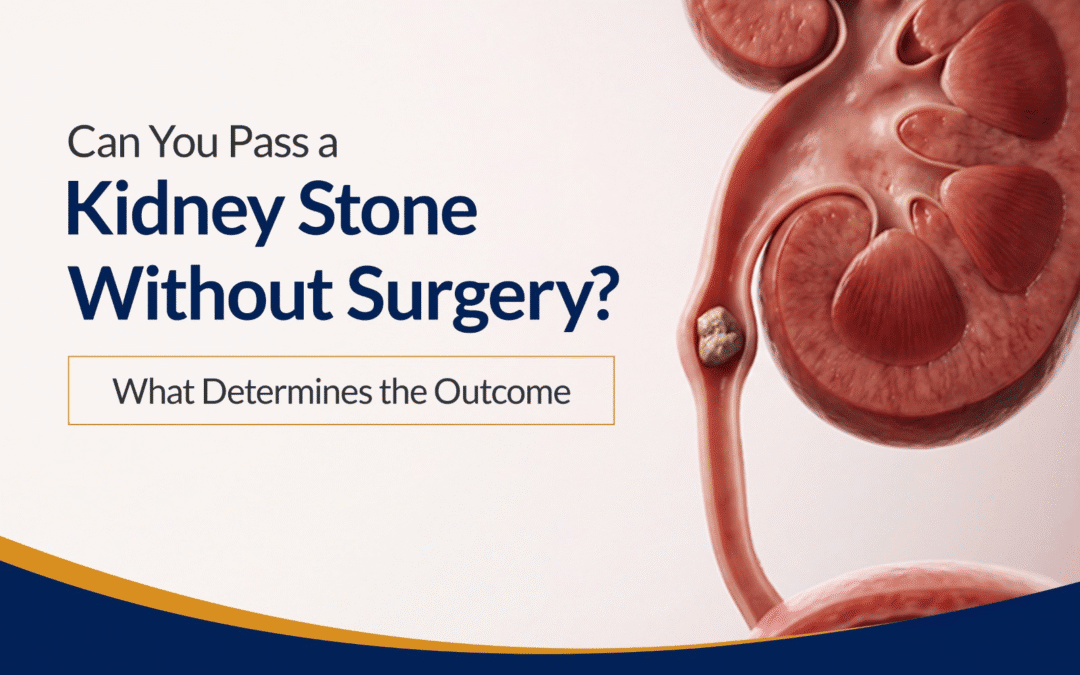
A kidney stone may be tiny, but it has an impressive talent to cause immense pain and trouble. If you have just been diagnosed with one, your immediate question may be, “Do I need to undergo surgery to remove it, or can this stone find its way out itself?”
The good news? Not every kidney stone requires surgery. Some stones can pass naturally, while others may need medical treatment depending on their size, location, and whether they are blocking the flow of urine or causing other problems.
What Is a Kidney Stone?
Kidney stones are hard lumps that form in your kidneys or in the ureter (the tube that connects your kidneys to the urinary bladder).
These lumps are made of minerals and chemicals in the urine. Kidney stones can be as small as sand grains or as big as pebbles. There are 4 types of stones.
- Calcium oxalate: Most common type where calcium binds with oxalate, a naturally occurring substance in many foods.
- Uric acid: Another common type that forms when certain foods and drinks increase uric acid levels in your body. Obesity is one factor that increases the risk here.
- Struvite: It is caused by infection in the kidneys or urinary tract. It’s a less common form.
- Cystine: It occurs as a result of cystinuria, which is an inherited condition.
How Do Kidney Stones Stop?
Our urine contains minerals and chemicals that are naturally removed from your body. When some of these substances become too concentrated in the body, they form crystals that eventually form into stones.
Factors that affect the formation of kidney stones include: [a] not drinking enough water, [b] a high-salt or high-sugar diet which increases calcium, [c] consuming too much animal protein, [d] family history, [e] health conditions like obesity, gout, kidney diseases, and Crohn’s disease, and [f] high doses of vitamin C, calcium supplements, and other medicines.
Can You Pass a Kidney Stone Without Surgery?
Yes, you can. Most kidney stones that are smaller than 5 mm can pass on their own. True dissolution, where the stone breaks apart chemically, is only possible in the case of uric acid stones.
Size is the biggest factor that determines whether or not the stone can pass. Here’s a quick guide:
- 1 to 4 mm → Pass on their own most of the time.
- 5 mm to 10 mm → Gray zone, which is managed with strategies and close follow-ups.
- Above 10 mm → Almost always requires a procedure.
Your urologist can use imaging techniques like an ultrasound or a CT scan to find out the stone’s size, position, and whether it’s blocking the urine flow or not.
Strategies for Passing the Stone Naturally
Below are a few strategies that can help individuals pass the small stones naturally.
1. Drinking lots of fluids
The goal of drinking lots of fluids is to keep your urine pale or clear. In concentrated urine, the minerals that form stones are more saturated. Diluted urine slows the growth of crystals and helps wash tiny pieces through.
2. Consume Citrate
Citrate works in two ways:
- Calcium binding: Citrate binds itself to calcium to form a soluble complex. This prevents calcium from binding with oxalate.
- Inhibits the process: It also directly inhibits the creation, development, and aggregation of crystals.
Natural citric acid is found in lemon juice and other citrus fruits. One easy way to add flavor to your water is to squeeze some fresh lemon juice into it over the day. This will not eliminate an existing calcium stone, but may inhibit development and help prevent future ones.
When Do You Need Surgery for a Kidney Stone?
Your urologist may recommend medical intervention if [a] the stone is unlikely to pass naturally due to its size or location, [b] the stone is creating a significant blockage, [c] the pain is uncontrollable, [d] there is an infection, and [e] your kidney function is at risk.
Treatment Options for Larger Stones
For larger stones, your doctor can recommend:
- Shock wave lithotripsy (SWL): It is a non-invasive technique that involves the use of shock waves to break a stone into smaller pieces.
- Ureteroscopy: This procedure uses a small instrument (thin scope) which is passed through the urinary tract to locate and treat or remove the stone.
- Percutaneous Nephrolithotomy: A surgical procedure that allows your doctors to reach large and hard-to-reach stones.
Which Foods Increase the Risk of Kidney Stones?
Below is a table with common items that increase the risk of kidney stones:
| Category | Items |
| High sodium foods | Processed and packaged foods, fast food, canned items, processed meats |
| Oxalate-high foods | Spinach, beets, and almonds. |
| Animal protein | Red meat, poultry, fish, shellfish, eggs, and organ meats. |
Frequently Asked Questions
How long do kidney stones stay in the body?
Smaller stones (1 to 4 mm) pass within one to two weeks. Stones between 4 and 6 mm may take about 45 days to pass naturally, and those larger than 6 mm may take up to 12 months. These larger stones may not pass at all without assistance.
How does the stone affect your kidney?
The most common symptom is an intense but fluctuating pain. It begins in the lower back and can radiate to the side or groin area. This pain usually occurs when the stone moves or obstructs urine flow. Another side effect is kidney swelling and damage. There is also an increased risk of urinary tract infections, which present with fever and chills.
Does drinking more water make kidney stones pass faster?
Adequate hydration helps maintain urine flow and is important for kidney stone prevention. However, drinking excessive amounts of water does not guarantee that a stone will pass. It’s best to follow your doctor’s guidance.
Conclusion
Two main factors that affect the outcome of a kidney stone are size and location. Smaller stones are easier to pass in the urine. Moreover, stones that are located lower in the tract are easier to pass compared to the ones in the upper part of the tract.
The safest way to go about this is via a urological assessment and imaging scans. Our urology department at Dubai Medical University Hospital is expert at treating kidney and urinary stones, infections, and other concerns. They will collaborate with you to understand your concerns and offer all the necessary guidance.
