



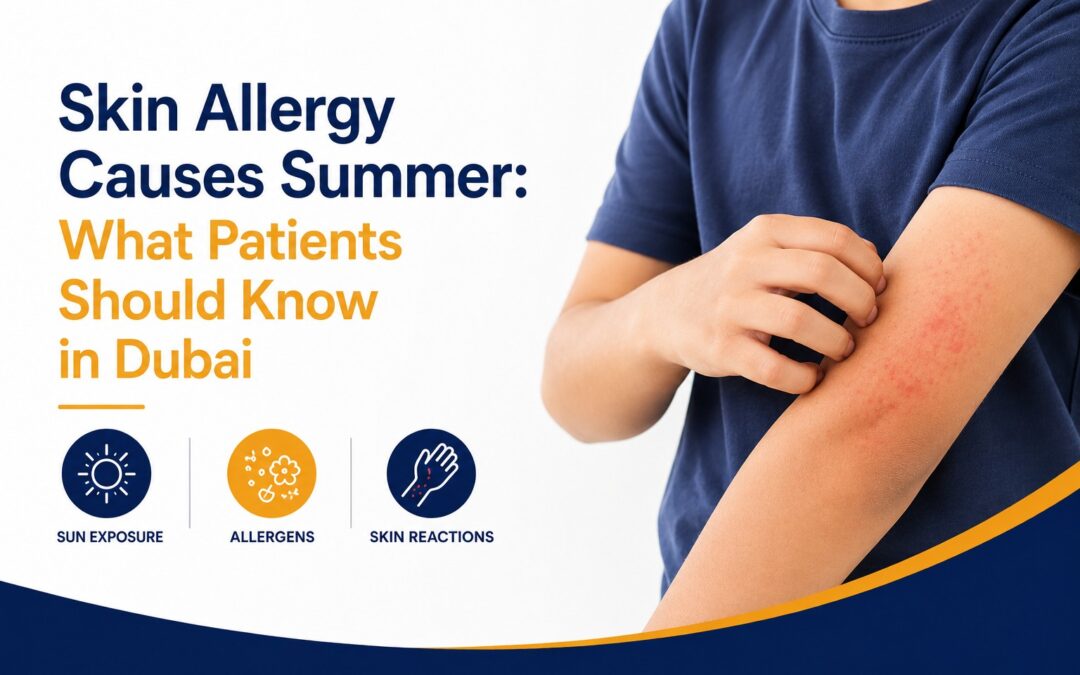
Skin Allergy Causes in Summer: What Patients Should Know in Dubai
Dubai’s summers are nowhere close to your usual summers. The temperatures easily reach 40°C to 45°C, and the humidity jumps to almost 90%. The blazing heat is a real challenge for all individuals, especially those with sensitive skin.
It can cause skin reactions and leave you uncomfortable, thanks to the heat, humidity, sweating, sun exposure, and environmental allergens.
Many people notice itching, redness, rashes, or irritation during the warmer months but are often unsure whether these symptoms are caused by an allergy, a skin condition, or environmental factors. If you’re experiencing recurring skin irritation during the hotter months, learning about what can be possibly causing them is the first preventive step.
What Is a Skin Allergy?
Allergy is a hypersensitive state that results from exposure to a particular allergen (cause). It manifests itself in various ways, ranging from mild and delayed-onset reactions to life-threatening reactions that develop within seconds.
In case of skin allergies, the cause or the allergen is often airborne (transported by air) or in direct contact with your skin.
There are different kinds of skin allergies, such as eczema, contact dermatitis, and sun-related allergic reactions. Below is a quick understanding of contact and irritant contact dermatitis.
- Contact dermatitis: Develops when your skin comes in contact with something and reacts to it, like jewelry and hair dyes.
- Irritant contact dermatitis: Occurs when a substance directly damages the skin after repeated or prolonged contact.
How Does Dubai’s Summer Climate Affect Your Skin?
Dubai experiences stinging heat with high humidity in summers. Consequently, it increases the amount of time people spend in air-conditioned indoor environments.
These affect the skin in various ways, starting with increased sweating when outdoors. The sweat mixes with the dust, makeup, sunscreen, and skin oils to clog your pores and irritate the skin. The frequent transitions between outdoor heat and indoor dry air worsen dryness, which in turn can worsen existing skin conditions.
Causes of Skin Allergies in Summer
Here’s a brief overview of some common reasons behind skin allergies.
1. Trapped Sweat
Sweat, by itself, is not allergic. However, when your sweat gets trapped under the skin because of blocked sweat ducts, you can experience “miliaria.”
Miliaria, commonly known as heat rash or prickly heat, causes inflammation in the skin. There are 3 levels to this condition.
- Miliaria crystallina: It’s the mildest form that results in small, clear, fluid-filled blisters. They break easily and usually do not itch.
- Miliaria rubra: This stage is what you call “prickly heat.” It develops in deeper skin layers, manifesting itself as red, itchy bumps. There’s a chance you may feel a stinging sensation.
- Miliaria profunda: It is less common but a severe form, wherein you will notice goosebump-like flesh-colored bumps. They can be painful and itchy.
Sweat can also worsen existing skin conditions, such as contact dermatitis. When sweat accumulates on the skin, it can disrupt the skin’s barrier and open it up to irritants. The same sweat can also dissolve substances in your clothing and other irritants, which can enter your skin.
2. Mold
Although the weather in Dubai is dry, the humidity inside the homes and offices can trap moisture. It creates the perfect environment for molds to grow, especially around vents, ceilings, and on walls behind the furniture.
Mold dermatitis is a skin condition wherein your immune system responds to exposure to mold spores, fragments, or mycotoxins. You can develop the reaction either through direct contact or via air. Affected skin can turn red, dry, or scaly. It may also feel itchy and tingling.
3. Pet Dander
Pet dander refers to the minute skin flakes and proteins found in a pet’s saliva, urine, and sweat. They can easily become airborne and settle on different surfaces. What makes it problematic is that you cannot see it or remove it completely.
If you come in contact with pet dander, your sensitive skin can develop hives, eczema, or rashes.
4. Swimming Pools and Chlorine Sensitivity
Swimming is a popular way to stay active during Dubai’s summer. However, there’s a chance that this very pool is irritating your sensitive skin. How?
Swimming pools contain chlorine, a strong chemical that acts as a disinfectant. Given its drying nature, chlorine can worsen existing eczema or psoriasis. You may also experience itchy, red skin or hives (itchy bumps) due to hypersensitivity to this irritant.
If you have asthma or allergic rhinitis, chlorine sensitivity can also manifest as (1) coughing, (2) trouble breathing, (3) runny nose, (4) itching, (5) sneezing, and (6) stuffy nose.
Can Existing Skin Conditions Worsen in Summer?
Yes, it can! The heat, sweating, mold, dryness, and other aspects of summer weather can exacerbate your skin issues. Some of these conditions are
- Eczema: Characterized by dry, itchy, and inflamed skin
- Psoriasis: Marked by scaly patches
- Chronic urticaria or hives
Seeing a Dermatologist in Dubai
Occasional and mild irritation may improve with simple at-home remedies and moisturization. Visit a doctor if (1) your symptoms don’t get better even after home care, (2) your rash and allergies start spreading, (3) you’ve developed blisters, or (4) it becomes very painful.
FAQs
Are summer skin rashes always caused by allergies?
No, skin rashes are not always caused by allergies. Excessive sweating, heat, friction, and tight clothing can also cause rashes.
Can heat trigger skin allergies?
Heat itself cannot trigger allergies. However, it can increase sweating and itchiness and worsen existing skin conditions. These changes can make allergy-like symptoms more noticeable.
How can I tell if my sunscreen is causing allergies?
See if you experience redness, itching, burning, or a rash consistently after applying your sunscreen. Read through the label carefully and see if any of the ingredients are damaging your skin.
Conclusion
Dubai’s summer climate can create conditions that increase your chances of skin irritation and allergy-like reactions. While many mild reactions improve with care and prevention, persistent or recurring signs should not be overlooked.
Dermatologists at the Dubai Medical University Hospital (DMUH) can help you identify potential triggers and provide guidance to improve your skin health over time.
This article is for informational purposes only and does not constitute medical advice. Always consult a qualified healthcare professional for diagnosis and treatment. If you are experiencing a medical emergency, call 998 (UAE) or visit the nearest emergency room immediately.
